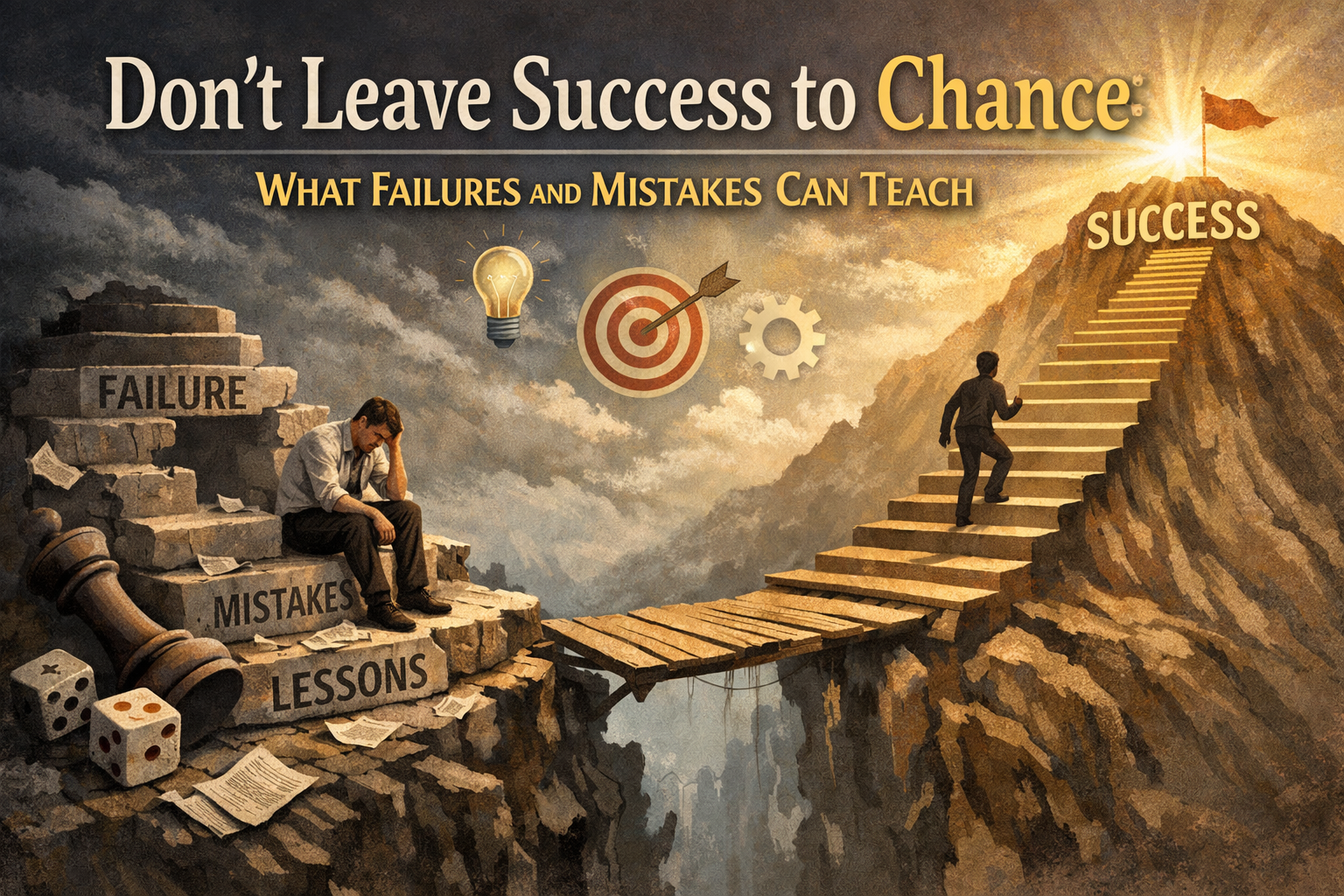
Don’t Leave Success to Chance: What Failures and Mistakes Can Teach
When I was a high school senior, I thought I should have been named valedictorian.

When I was a high school senior, I thought I should have been named valedictorian. My grades were higher than the student who received the honor.
Dad listened to my frustration and then gave me advice that stayed with me for the rest of my life:
“You left too much to chance.”
With the benefit of hindsight, I eventually realized that the school had made the right decision, even though it had to bend its pre-announced criteria to do so.
My classmate had gone all out to improve the life of the school. He was captain of two sports teams, president of the student council, and someone who generously opened his home to classmates. He was an extraordinary ambassador for the school both internally and externally.
I, by contrast, had spent most weekends participating in debate tournaments. I had worked hard academically, but had not invested very much in the institution’s broader life.
I realized that my father’s advice applied far beyond high school. The most valuable lessons often come from moments when things do not turn out as expected.
Sometimes those moments are failures, situations in which we make reasonable decisions or even make an all-out effort and still end up with disappointing results.
Sometimes they are mistakes, decisions that, even at the moment they occur, are clearly misguided.
The difference matters. But what matters even more is what leaders do next: whether they are willing to examine what happened honestly and learn from it.
Many of the most important decisions I later made as a Pitney Bowes executiv were shaped by lessons drawn from earlier failures and mistakes.
Failures occur constantly in business and in life. Baseball offers a useful analogy. Great hitters fail roughly 70% of the time. Great pitchers lose about 30% of their games. Great teams lose 40% of the time.
Failure is not unusual. It is inherent in any competitive endeavor.
A mistake, however, is different. It is a decision or action that is clearly misguided even at the moment it occurs.
Michael Lynton, the former Chairman and CEO of Sony Pictures Entertainment, described such a moment in his book From Mistakes to Meaning. In 2014 he approved the production and release of The Interview, a satire in which journalists assassinate North Korea’s dictator.
The consequences were catastrophic. North Korean hackers penetrated Sony’s computer systems, shut them down for months, and released enormous volumes of confidential data, including deeply personal employee information.
The following year Lynton met with President Obama, who asked him a simple question: “What were you thinking?”
That question usually follows a true mistake.
Yet whether the situation involves a failure or a mistake, something counterintuitive happens when organizations analyze them honestly. The process of understanding what went wrong is not just informative, it is therapeutic.
Early in my Pitney Bowes time as an executive officer, I had to inform our CEO that a proposed distribution agreement with a French postage meter company had collapsed. We had pursued the partnership repeatedly since 1956, but the U.S. Justice Department’s Antitrust Division repeatedly refused to approve it.
To represent us in this matter, I had retained an exceptionally capable outside counsel who had previously led the Antitrust Division. The choice proved to be a serious liability.
The Justice Department attorney reviewing the matter was openly suspicious of him and of us. Eventually we learned why. She had once worked for him and believed he had “sold out” too often to large corporations seeking regulatory relief.That perception shaped how she interpreted everything we submitted.
The lesson was clear. Whenever we retained outside counsel who had previously worked at a regulatory agency, we needed to understand their reputation among their former colleagues. They could be a tremendous asset or a serious liability.
I shared that lesson candidly with our CEO. He appreciated the reflection.
Later in my career, an even larger failure led to my election as President, Finance Services. Our German leasing operation produced approximately $100 million in credit losses, one of the largest financial disasters in our history.
When I became CEO in 1996, I insisted that we study the episode in depth rather than bury it. A project team analyzed what had happened and presented its findings to our executive leadership council.
Three lessons stood out.
First, brokers originated most of the leases. We had no direct customer relationships and therefore had limited visibility into their creditworthiness.
Second, the German CFO, who reported solely to the local CEO, did not feel empowered to report the wrongdoing he suspected. We corrected this by creating a dual reporting relationship with the corporate CFO and strengthening our ethics and whistleblower systems.
Third, we realized that even when international executives speak perfect English and appear culturally similar, their business norms and values can be very different.
These lessons had strategic consequences. Over the following decade we exited non-core financial services businesses, particularly those outside the United States. That decision ultimately helped protect Pitney Bowes from the worst risks of the 2008 financial crisis.
We applied the same discipline even to smaller setbacks. In 2001 our Management Services business lost its largest client, Bank of America, during a contract renewal.
The explanation initially seemed simple: our price was too high and we had not cultivated strong enough relationships with the key decision maker.
But months later a regional vice president told me something revealing. The real problem had occurred more than a year earlier. Bank of America had quietly signaled that it wanted a smaller and less expensive contract structure. We failed to respond to those signals. By the time the formal bidding process began, the outcome was already left too much to chance.
From then on I asked our teams to review major customer relationships well before renewal decisions approached. Three years later we won the Bank of America business back.
What makes the analysis of mistakes and failures so valuable is that their roots often lie deeper than the immediate decision.
Michael Lynton eventually concluded that his decision to release The Interview was influenced by something from his childhood. As a teenager he felt like an outsider and wanted desperately to be seen as “cool.” Supporting the film allowed him, in that moment, to feel accepted by the actors and studio insiders around him.
Understanding these deeper motivations takes time. But when leaders encourage that level of reflection, they give their organizations a powerful gift: freedom from fear. People become willing to examine what went wrong honestly rather than hide it.
That shift from fear to curiosity is where learning begins. Curiosity allows organizations to explore a wider range of explanations and solutions. It converts painful experiences into sources of insight and agency.
Looking back over my career, I have come to believe that leaders should approach failures and mistakes in three deliberate ways.
1. Create permission to analyze what went wrong.
Organizations often try to bury disappointing outcomes quickly. That instinct wastes valuable insight. Leaders should encourage teams to examine failures candidly and without fear.
2. Look beyond the immediate decision.
The most important causes of mistakes and failures often lie deeper—in organizational structures, incentives, culture, or personal motivations.
3. Translate lessons into structural change.
Reflection is valuable only if it leads to action. At Pitney Bowes, our reviews of failures led to changes in governance, reporting structures, customer management practices, and ultimately our long-term strategy.
When organizations do this well, failures become investments in future success rather than sources of embarrassment.
Leadership is not about eliminating mistakes and failures. That is impossible in any complex organization.
The real discipline of leadership is ensuring that every mistake and every failure leaves the organization wiser than it was before.