Mike Critelli

Mike Critelli,
Retired Executive
Chairman,
Pitney Bowes

About Mike Critelli

Why I Blog

Recent Posts

Topics

Search

Archives


Lack of CEO engagement in employee health

May 10th, 2013

I have strongly believed that CEOs should make employee health a high priority and have been bewildered when they delegate that responsibility to their Benefits departments.  I successfully created a culture of health at Pitney Bowes, but relatively few CEOs have followed my path.

However, some smart and rational CEOs, whose scarcest resource is time, believe that they can deliver shareholder value by putting their priorities elsewhere.  Their reasoning may be as follows:

  • Traditional population health improvement programs have not worked in large organizations; and
  • The best path to reduced healthcare costs may be to reduce U.S. employee headcount.

Few employees use wellness, disease management, and care management programs. Since employers usually pay a vendor fee for these programs over their entire population, they generally fail to produce a population-level economic return. Why do so few employees use them? The most obvious reason is that the vendors have no incentive to maximize participation, since it increases their costs and reduces profitability.

However, these programs fail to draw widespread participation even when employers and vendors aggressively market them. Understanding why is critical to improving population health.

Most people only use wellness programs when they can be fit into their daily life routines.  Moreover, many employees consider mandatory wellness program participation to be an unwarranted intrusion on their private lives, and a bad example of the “nanny state.”  How can employers get buy-in from all those who should use the programs?

First, employers need to educate employees that increased healthcare spending reduces the amounts available for salary increases and other cash-based benefits.  They also need to explain that uncontrollable labor costs make a wide range of headcount reduction strategies more economically viable.  What are CEOs who do not attend to improving population health doing instead?

Unfortunately for already insecure employees, one answer is that they are aggressively looking for ways to reduce U.S. headcount.  How are they doing it?

  • They will substitute technology for labor wherever possible. Automated voice response systems replace human operators. Robots instead of people move physical items. Heavy equipment replaces construction workers in moving dirt.  We will also see an evolution toward the eventual penetration of self-driving automobiles, which will eliminate jobs for millions of truck, bus, taxicab and limousine drivers.
  • More tasks will be offloaded to offshore workers in low labor cost markets.
  • More tasks will be outsourced to more technologically efficient and enabled third party administrative services.
  • More tasks will be done by contract workers of short duration, employees who are being tested in a 30-90 days “probation” period, or even unpaid interns.  Companies also refer more work to teams of undergraduate or graduate students who will trade compensation for school credit.
  • Businesses create more customer self-service opportunities, as airlines have done for over two decades in creating automated reservations systems, and, more recently, automated systems for securing boarding passes.  Retailers will expand customer-managed checkout processes.  Even restaurants will move slowly, but surely, toward more automated ordering and food pick-up systems.
  • Big data analytic systems will replace highly skilled human tasks, such as Amazon.com and Netflix have employed in building recommendation systems for book and movie acquirers.  Even law firms are now authorized to use technology to sort documents for responding to certain government document production requests, saving client money and lawyer labor.
  • Healthcare will move from face-to-face human interactions to technology that automates physical examination, and non-invasive self-administered biometric monitoring will reduce the need for more skilled healthcare professionals.

However, CEOs are employing two other strategies as well for reducing healthcare cost burdens:

  • Companies locate facilities in areas with better-educated and healthier populations, and lower healthcare costs. They require higher levels of education for each job and benefit from the fact that higher educational attainment correlates with better health.
  • Finally, they substitute part-time employees for full-time employees to reduce the population for which they have healthcare benefit responsibility.

However, after they exhaust all low-hanging fruit that enables them to avoid having to improve employee health, they will realize that, for the core of their stable, mission-critical, full-time U.S. workforce, they will need a robust population health and healthcare cost management strategy.

For that population, they will need to reinforce a culture of health inside an organization by executing on strategies and tactics that improve health. They can change the daily environment in which employees function, either directly at work, or using their influence, indirectly in the community and at home.  Well-respected public health researchers like Sir Michael Marmot and Dr. Anthony Iton, (the author of a wonderful study called Death by Unnatural Causes, when he was the Public Health Director for Alameda County Californida) have demonstrated that 85-90% of what determines our health happens outside the healthcare system.  Our daily living environment drives our health outcomes much more than access to high quality healthcare.

The recently released State of Oregon study on its Medicaid population, demonstrated that while those citizens on Medicaid had easier access to healthcare and avoided financial ruin, they had no better health-related outcomes than those not participating in the Medicaid program and the total amounts spent on their healthcare were not lower.

How can an employer alter the daily working environment of employees to make it better?

  • Make healthier foods and beverages and lower portions of them more affordable and accessible than junk food, although employees are less likely to rebel if they retain the choice to eat less healthy foods.
  • Make all facilities tobacco free.
  • Create facility plans and work processes, which induce more walking during the day.  Eliminate desktop printers, reduce the number of private offices, and create attractive stairways in place of elevators to induce walking.
  • Have fewer meetings of shorter duration to reduce forced sitting down, since prolonged sitting is one of the least healthy activities in which we engage every day.
  • Have more ergonomically friendly furniture and furnishings and LED lighting in all workspaces.

Even if employers do not particularly care about the per-employee cost of healthcare, under ObamaCare, the non-deductible 40% excise tax, sometimes called the “Cadillac tax.” is based on the per-employee cost, not the total healthcare cost budget.  That tax will hit all employers who fail to manage their per employee healthcare costs below $10,200 in 2018.

ObamaCare has many conceptual flaws, but if it forces employers who have the best ability to influence employee health and healthcare cost management, to tackle the problem, it will have at least that as a positive, if unintended, outcome.


Is a publicly traded asset ever a “safe investment?”

April 29th, 2013

What is a “safe investment?”

As I have attempted to secure investors for our feature film From the Rough, I have gotten extremely frustrated by comments many people have made that our investment is much “riskier” than putting their money in publicly traded stocks and bonds, or even real estate construction.

An article entitled “Tim Cook vs. Steve Ballmer” written on April 23, 2013, by Zach Epstein, the Executive Editor of an online portal called BGR, points out that investors are calling for the ouster of Tim Cook, the Apple CEO, who has presided over a 40% decline in Apple’s stock since he succeeded Steve Jobs, just as they have called for the ouster of Steve Ballmer, the Microsoft CEO who succeeded Bill Gates in 2000, while Microsoft stock has declined by 43%.

http://bgr.com/2013/04/23/tim-cook-vs-steve-ballmer-nyt-459167/

More »

Why life’s small moments often have big consequences

March 23rd, 2013

I just finished reading Cissy Houston’s remarkable book Remembering Whitney, which is partly Cissy Houston’s autobiography and partly a story of her daughter Whitney Houston.  It is a remarkable book in so many ways!

What makes it most remarkable is Cissy Houston’s ability to recall small, but important, moments in her own life, as well as the life she shared with Whitney Houston.  Relative to her own life, she shared several stories about how she would use a new technique in background singing to give a prominent artist’s song more life and richness.  She clearly took her craft very seriously, but, more importantly, she opened the minds of the artists she supported as to the potential for their musical performances they had not previously appreciated.

More »

Celebrating innovative everyday heroes

March 17th, 2013

Celebrating everyday heroes

Type 1: the person who performs a single dramatic heroic act

When we talk about celebrating everyday heroes, we should pause to redefine what we mean.  When I was growing up, a hero was someone who did something “extraordinary” and positive for others or for the community at large.  We became accustomed to defining heroism in terms of saving someone’s life, such as a firefighter who entered a burning building to rescue someone or the police officer who saves a citizen’s life.

Type 2: the person who plays a vital role in a bigger heroic effort

More recently, we have expanded our definition of a “hero” to include those who provide a vital contribution to a major accomplishment, such as the work many unsung heroes played in winning World War II, as Paul Kennedy profiled in his great book Engineers of Victory: The Problem Solvers Who Turned the Tide in the Second World War.  On Saturday, March 16, 2013, I attended a wonderful event for the Explorers’ Club, which celebrated both a few very famous people, like Senator John Glenn and Mercury Astronaut Scott Carpenter, and both of these kinds of heroes.

The Explorers Club celebrated a Sherpa who saved many people’s lives in mountain-climbing accidents in Mr. Everest, who would be like our first kind of hero. James Cameron, the director of Titanic, who did a number of deep oceanic exploration efforts, credited a number of engineers like a wonderful gentleman named Kevin Hardy from San Diego’s Scripps Oceanographic Institute with being essential to his success.  Hardy, with whom I spoke at dinner Friday evening, designed and built the unmanned capsule that descended to the bottom of the Mariana Trench, the deepest part of the ocean in the world, took photos and captured other data essential to preparing Cameron for his deep dive in 2012.

Type 3: The person whose cumulative body of work is heroic, but is insufficiently recognized or rewarded

However, there is a third kind of hero, which we do not explicitly celebrate, but should:  the person who consistently develops innovative solutions that make a big difference in the lives of those he or she touches every day.  Often, these innovative solutions are not documented, and, as a result, they are not celebrated in books, movies, plays, or even in recognition events like the Explorers Club event, although the Explorers Club comes closer than any organization I have seen to recognizing this kind of unsung hero.

Along these lines, I was pleased to read today that baseball will be honoring Dr. Frank Jobe at the July 27 Hall of Fame induction ceremony for his pioneering work in what is now called “Tommy John” surgery.  Dr. Jobe invented that surgery on the baseball pitcher, Tommy John, who had damaged his pitching elbow to the point that his chances of recovering and pitching again were estimated at 1 in 100.  His ligament grafting process, invented in 1974, increased the chance of full recovery to over 90% today. Dr. Jobe has contributed to the career successes of several dozen pitchers and position players and has probably been responsible for billions of dollars of enhanced value for baseball team owners, only a fraction of which has gone to him.  Although he is a wealthy man, he is a relatively unsung hero in baseball and other sports.

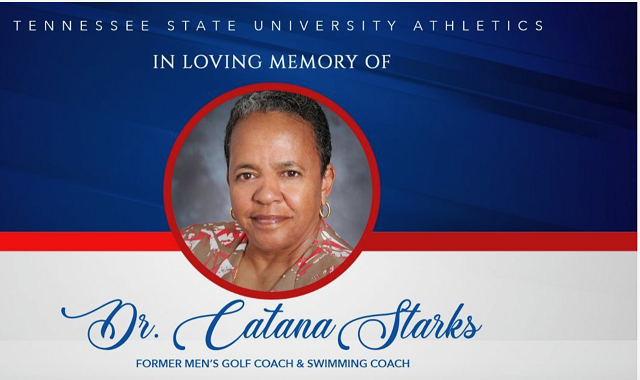
Coach Catana Starks: the ultimate example of the third type of everyday hero

However, to me, the everyday hero we should celebrate in entertainment, books, and recognition events is the person who innovates everyday in multiple situations, changes the lives of many other people, but does not get recognized publicly for much of what he or she does, and often is far more under-rewarded than Dr. Jobe.  That is why I have put the story of Dr. Catana Starks on screen, and why her story and others like it need to be told.

Our film could only scratch the surface of what Coach Starks was able to do over a lifetime of coaching.  Part of the reason was because she did her job in such a quiet way that it was difficult to dramatize some of her accomplishments within the time constraints of a full-length feature film.  Part of the reason was that she did not think to tell us what she had done because she did not appreciate how heroic it was.  Finally, the major part of the reason was that her heroism was not the single, easily definable accomplishment that could be the subject of a large project, but the cumulative effect of many smaller, innovative acts that made a big difference in the lives of those she touched.

What we would have liked to celebrate, but did not get a chance to celebrate, were many small acts of daily heroism about which we either learned from Coach Starks after we finished shooting the movie, or from others.  There are many stories about Coach Starks, and they fit into three categories:

  • Redefining adversity as opportunity;
  • Seeing opportunities to make a difference in situations that no one else saw; or
  • Using scarce resources in novel ways.

Redefining adversity as opportunity

Coach Starks did not have the budget or the established, prestigious program to recruit the most sought-after golfers, so she often had to recruit people who were from less advantaged backgrounds.  Her genius or “heroism” was her innovative way of convincing them that their apparent “disadvantaged” backgrounds prepared them better for the competitive challenges of life than the so-called “advantages” bestowed on their competitors.

My favorite story about Coach Starks in this regard was how she figured out that the “disadvantages” of not having enough money to afford hotel rooms the night before a tournament and of not having a big enough van to enable everyone to have a sleeper seat could be turned into an opportunity.  In the beginning, the person who sat upright in front with her on a long overnight drive was disadvantaged, but she gave that person a special treat, in terms of hours of conversation in which she presented life lessons.  The golfers with whom I spoke told me that they eventually came to see the front seat position as a better option for them than a sleeper seat, even though they had a less comfortable sleeping position.  Every one of them remembered those long conversations years later.

Seeing opportunities where others did not

Coach Starks was a teacher.  Many teachers have invited inmates from local prisons to speak to students about the problems of drugs and how they lead to bad behavior.  Coach Starks did that as well.

However, she went one step further.  She had one drug dealer speak who had been sentenced to life imprisonment from three felony convictions during his teenage years.  It prompted her to use her accumulated knowhow on coaching and mentoring to persuade the prison system to give him an opportunity to get treatment and eventually be released.  She became an advocate for reducing the sentences of those whose drug-related offenses occurred early in their adult lives and who had reformed during their prison tenure.

Using scarce resources efficiently

Coach Starks did not have the high-priced instructors or technology to help her team refine its golfing skills.  She came up with two innovative solutions:

  • She tapped volunteers in the Nashville area who gave her golfers free instruction at the driving range or on the public courses.  These volunteers became mentors beyond the help they gave players relative to their golfing skills.
  • She used a video-cassette recorder to capture the golf strokes of her golfers and then urged them to send the video cassettes back to their coaches in their countries or communities of origin.  This accomplished two things:
    • It gave the golfers instruction from someone from whom they had learned to play golf and who was intimately familiar with their technique; and
    • It reinforced a lifelong support system they would need for not only golf, but also everything else they would do.

I could have used many other examples of her innovation solutions to problems caused by resource scarcity, but there are too many from which to choose.  Her decades long success as a coach and teacher is the result of many small innovations, no one of which is dramatic enough to be the foundation for a piece of feature film or documentary entertainment, but the cumulative effect of which was huge.

Her story deserves to be told, and it will be told in public venues, beginning later this year in From the Rough.


Do high taxes cause wealthy people to leave a state or a country?

February 18th, 2013

James B. Stewart, a reporter and author wrote on Op-Ed piece in the Saturday, February 16, 2013, issue of The New York Times, entitled “The Myth of the Rich Who Flee From Taxes.”  His major argument is summarized in the following statement:

“At least three recent academic studies have demonstrated that the number of people who move for tax reasons is negligible, even among the wealthy.”

As a person who knows many wealthy people who have moved to states with no income or inheritance taxes, and many who have chosen not to do so, I am often asked by many people why we do not leave Connecticut and establish a primary residence in a state like Florida, where I could save millions of dollars in taxes over the rest of my life.  My view is that Stewart is only partially correct and partially wrong in his assertion that higher taxes do not drive people to change where they live.

More »

Kudos to Irving Kahn

January 25th, 2013

In the Saturday, December 22, 2012, issue of The Wall Street Journal, there was an inspiring story written by James Zweig called “The 107-Year-Old Stock Picker.”  The subject of the story was 107-year-old Irving Kahn, the chairman of the Kahn Brothers Group, an investment management firm based in New York City.  As Zweig describes him:

“He personifies the virtues that Graham (Benjamin Graham) spelled out in his classic 1949 book “The Intelligent Investor,” from which this column takes its name.”

Later on in the story, Zweig tells us more about Kahn:

“Discipline has been a key for Mr. Kahn. He still works five days a week, slacking off only on the occasional Friday.”

In answer to a question about his remarkable longevity, Kahn responds:

“Millions of people die every year of something they could cure themselves: lack of wisdom and lack of ability to control their impulses.”

Irving Kahn appears to be an individual firmly grounded in the real world, and as active as a 107-year-old can possibly be. Zweig commented: “In some ways, Mr. Kahn says, these are the good old days.”  As an investor, he correctly notes that he has more tools than ever available to level the playing field between investors and those from whom they buy securities.  His goal is to know more about the stock he is buying than the investor who is trying to sell it to him. He is energized by his job and his daily life, and his physical faculties have declined relatively slowly.

Although I have had many role models in my life, certainly Mr. Kahn has to be added to them.  I believe that the key to health and longevity is a continuation of one’s passionate commitment to family and friends, causes, and work.  When someone completely “retires” from active living, he or she actually increases his or her psychic burden.

The other key to healthy longevity is to live every day with the appreciation of life that a productive very old person carries through the day.  When I have met such people, very little that bothers me would bother them, because they have had a few extra decades in which to put life into perspective.

How do they think differently from someone at my age or someone far younger than I am?

  • They have been through enough up-and-down cycles in life to realize that neither success nor adversity is permanent.  Life has a mix of both every year for us.
  • Just as those who have had near death experiences tend to worry less about just about every other problem, those who have relatively short life expectancies tend to consider daily problems to be of lesser consequence.
  • They celebrate small successes every day.  At first glance, this would appear to be an acknowledgment that a person has failed to achieve more ambitious goals, but it actually increases the likelihood of more ambitious accomplishments.  Efficiently taking small, successful steps often gives an individual the ability to adapt to changed conditions and achieve success with fewer big failures.

Conversely, by encouraging older people to retire and disengage from active work, we inadvertently put them in a much more psychologically vulnerable position.  They lose the ability to see past the news headlines into the many good things that are happening.  They get fearful, when they should be celebrating the progress we are making on many fronts.

Why do I believe that to be the case?  Someone in the flow of the business, political, cultural, and community world has a much better understanding of reality than someone who gathers information from the mass media.  The TV media, in particular, is designed to report what it calls “news,” but what is typically a highly distorted and negative selection of the broader flow of events and trends.  Initially local news editors, but now national and global news editors as well, on all news stations select stories for broadcasting or printing based on the principle of “If it bleeds, let it lead.”

For this reason, although the world is less violent than it was two decades ago, and the absolute level of crime is the lowest it has been for decades, the sensational reporting of crimes gives the impression that violence is at an all-time high.

Recently, I met a highly accomplished journalist and author named Greg Behrman, who feels the same way I do.  We spend far too much time covering what’s wrong in the world, and not enough time spotlighting the things we are doing right, and that require considerable innovation in solving problems.  Think about this point for a minute in a number of contexts:

  • As a country, we are seeing a significant increase in the percentage of people that are overweight or even obese.  We have a true public health crisis in slow motion.  That is no longer news.  We see it all around us, particularly in the Southeastern United States, and in the lower income parts of big cities.

However, I learned that New York City has actually stopped and even reversed the incidence of childhood obesity, but I did not learn it from the news media, but from a speech given by Dr. Tom Farley, the City’s Public Health Commissioner.  I am sure that the advisory board meeting at which Dr. Farley spoke was not the first time at which this news was made public, but it would be difficult to find this story in the popular media.


  • We get the impression that we are a more violent world than ever before, but Joshua Goldstein recently published a book called Winning the War on War, which documents that the absolute level of armed conflict is declining over time.  Why do we not see these statistics dominating the airwaves?


  • The U.S. has had great success in several public health campaigns over the last four decades in reducing the percentage of adults who use tobacco, the likelihood of automobile related fatalities, the likelihood of workplace-related accidents, and the incidence of alcohol abuse.  This is not broadly or frequently reported.


  • Our air is cleaner, there is a lower incidence of acid rain, and the level of hazardous waste discharges in our factories is far lower than it was 40 years ago, but there is very little reporting on these positive environmental trends.


  • In many respects, medical science has enabled us to achieve a better quality of life than was possible when I was growing up.  My wife was an early beneficiary of lasik surgery, which eliminated her need to wear contact lenses or glasses for everyday distance viewing (although she still wears reading glasses.)

Whenever I am down, I think of Irving Kahn, but more importantly, I think of the old Frank Sinatra song That’s Life, particularly one section of the lyrics:

I’ve been a puppet, a pauper, a pirate, a poet, a pawn and a king

I’ve been up and down and over and out and I know one thing

Each time I find myself flat on my face

I pick myself up and get back in the race


That’s Life, That’s Life

I tell you, I can’t deny it

I thought of quitting, baby but my heart just ain’t gonna buy it.”


We should take a moment upon reading this and celebrate Irving Kahn and everyone like me who keeps getting “back in the race.”  For, in doing so, he has clearly discovered the true fountain of youth.


Football bounties and gamblers

January 4th, 2013

Every once in a while, a single comment in a book or article prods us to think very differently about a broadly discussed issue.  One that comes to mind is a statement in Steve Coll’s essay in the online version of The New Yorker magazine.  That essay, entitled “Is Chaos a Friend of the NFL,” posted on December 26, 2012, discusses two issues that have the potential to damage the NFL’s brand and economics over the long term: the “bounty” issue and the injuries that have led to many cases of long term damage to present and former players, including dementia, depression, alcohol and drug abuse, suicides and murders.

http://www.newyorker.com/online/blogs/comment/2012/12/is-chaos-a-friend-of-the-nfl.html

The comment that caught my attention was about the “bounty” issue, that is, the practice of coaches or players paying other players for success in injuring opponents so badly that they had to be removed from games or, worse yet, unable to play in future games. The practice is bad enough in creating injury risks for individual players and is offensive on that basis alone.  Indeed, it becomes another source of the second problem, causing long-term injuries to players in order for a team to win a game or to secure a better position in an individual season.

More »

Reflections at the beginning of the new year

January 1st, 2013

As we end 2012 and enter 2013, I have some observations about the world as I see it.

The economic environment

This is a very difficult economic environment for people of all ages, but particularly for young people leaving college, graduate school, or professional schools, except for those with very specific trade-based skills in which demand exceeds supply or for men and women with science, technology, engineering and math degrees.

Our colleges and universities are run highly inefficiently and tuition, book, room and board costs are wildly inflated.  They burden our students with huge debt loads and force them into long term financial servitude with education that, in many cases, is of marginal value in terms of their earning power.

However, what makes the situation worse is that what we reward throughout traditional education, including college, is the mastery of a bodies of knowledge as defined by school boards and individual teachers and professors, not the skill to use that knowledge to solve problems and propose solutions.  Our young people coming out of school are generally clueless on how to navigate the worlds they enter, whether those are business, government, the educational sector, or the nonprofit sector.  Part of this navigation process is recognizing that knowledge gets obsolete fast, but adaptability and emotional intelligence skills need to continue to improve.

The most destructive aspect of our education system is that it teaches both conformity and the creation of regulatory and legal obstacles to engineer risks out of our lives, and, while it achieves destructive conformity, it can never succeed in getting rid of life’s inherent risks.

More »

Reflecting on our blessings

December 25th, 2012

As my family and I celebrate the holidays this year, we truly feel that we have gone through a rebirth from the many challenges we have faced in the past few years.  Objectively, our path to get our film into the market has been strewn with obstacles, some of which resulted from our inexperience and others of which resulted from the fact that we are trying to do something very different from the kind of film traditional studios produce, finance, and/or distribute. Similarly, my efforts to battle the day-to-day challenges of leading Dossia have presented challenges I did not encounter when I led a more established business at Pitney Bowes.

Oddly enough, we are more energized and happier at this time than ever before.  As I reflect on this strange feeling of happiness as a result of the adversity we have experienced, I think of a quote from Helen Keller:

“A happy life consists not in the absence, but in the mastery, of hardships.”

More »

The Critical Role of Genetics and Genomics in the Future of Healthcare

December 17th, 2012

In talking with Dr. Robert Green, one of the handful of leading-edge researchers and thinkers on the promise of genomics in transforming health and healthcare, I have gained some quite interesting insights.

Dr. Green is a physician-scientist at Brigham and Women’s Hospital and the Harvard Medical School and has focused much of his professional life on a subject of great passion to me, patient empowerment.  As strange as it may sound, he has had to do a considerable amount of clinical study work to prove to the medical community that the consequences of doctors telling patients that they are at serious risk of a degenerative and currently incurable disease are, on balance, positive.  His work in that regard has been done through a series of studies called the REVEAL Study, for which he has been the principal investigator.

More »

Blog On New Feature: Selling, Giving, Re-using And Recycling Nearly Everything


Subscribe to my feed

Google Reader or Homepage
Add to My Yahoo!
Subscribe with Bloglines
Subscribe in NewsGator Online

To receive new posts via email enter your email address.